Bruce sets up on Fountain Avenue at 3 a.m. On the days he works, Tuesdays, Fridays, Saturdays and Sundays, he arrives in the dark to claim a spot. Then he hangs racks of clothes priced at $1, $2 and $5, lays out brand-new blankets, and sells whatever came out of the storage units he bought that week.
“This is basically my job, my career, is how I support my family,” Bruce said. “We want to do this the legal way, but for now we do it this way because it pays the bills.”
Bruce has vended on his own for six years. He’s second generation. His mother sold at the flea market for about 15 years, he said, and that’s where he learned the trade. “We can’t afford yet to get our own store, which is why we’re out here,” he said.
For years, vendors like Bruce had almost no way to get a license. That is starting to change.
From the lot to the sidewalk
Many of these sellers trace their roots to the Aqueduct Flea Market, which ran at the racetrack in Queens until 2010. The market then moved to a lot at 700 Fountain Avenue as the AquaDuck Flea Market. When its lease ended in 2023, more than 300 vendors were left looking for somewhere to sell, News 12 Brooklyn reported. Many stayed on the sidewalks nearby.
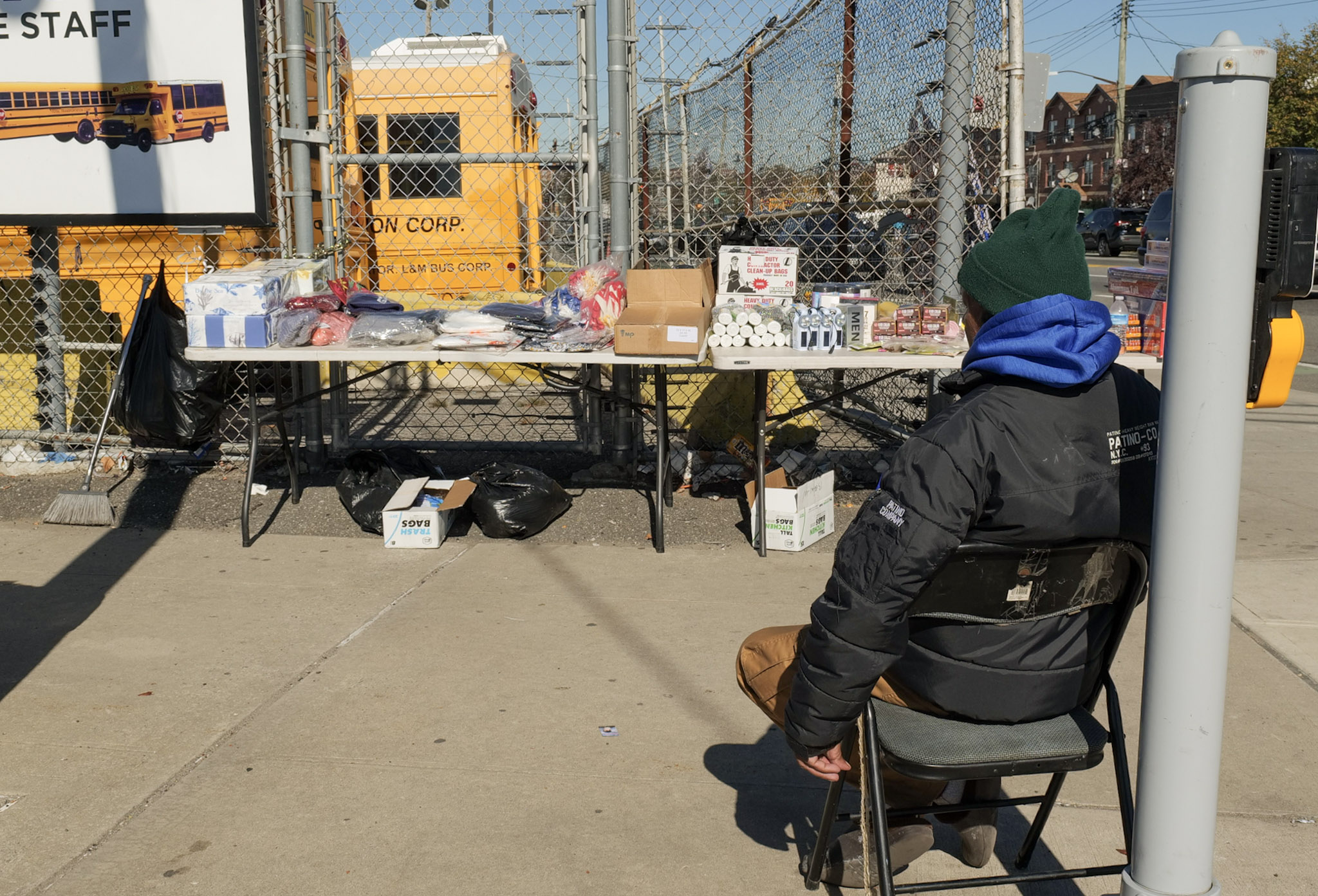
On a recent visit by The East New York Times, coats and jackets hung from a chain-link fence topped with barbed wire, and clothing and household goods covered the sidewalk around a fire hydrant. At Fountain and Cozine avenues on Sunday, Oct. 25, one vendor sat on a folding chair beside a table of boxed household goods, waiting for customers.
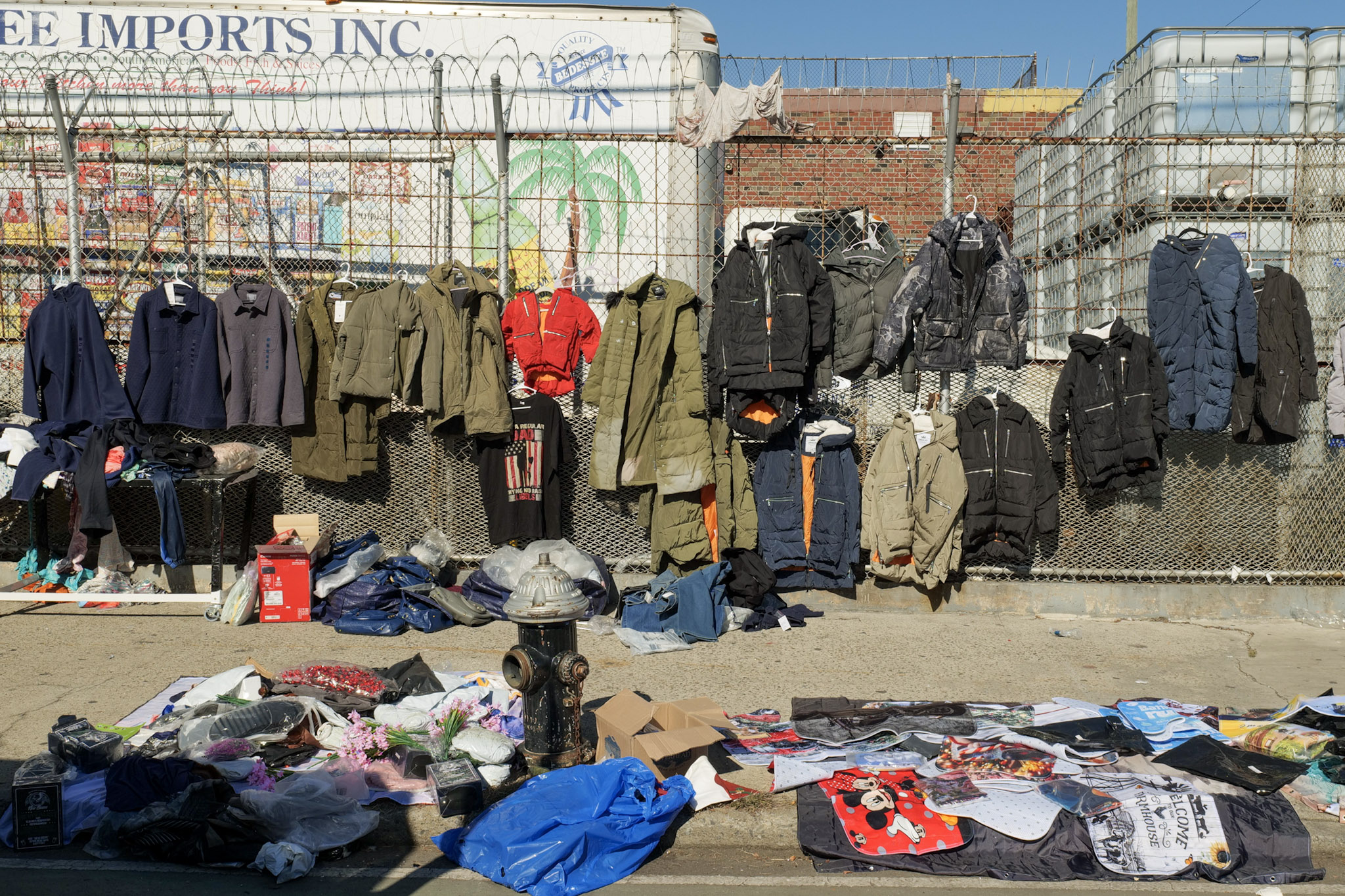
Photo Credit: Deric Johnson
Making a living on the sidewalk
Janette, another vendor, said the money made on this sidewalk pays for rent and car notes, and puts some families’ kids through college. She said she also feeds homeless people in the area.
“I am my own boss,” she said.
Janette said she has gone to a vendors’ office on Rector Street in Manhattan for help and was told no new licenses were being issued. She said her daughter’s husband, a veteran, tried to apply for a veteran license and still hasn’t received one. The city places no cap on licenses for veterans, according to the DCWP FAQ.
“A lot of people is crying now,” she said. “They have no alternative, nowhere to go.”
Bruce said the vendors look out for each other. “We’re all like family, we’re all like brothers and sisters, we help each other out,” he said.
The trash problem
Vendors know what neighbors complain about most. “I know there’s a misconception of out here people leaving trash,” Bruce said. “We try to go around and talk to people and have this place clean, because I know that’s really what is against us.”
One vendor said he would gladly pay into a city-run trash system if everyone had to. He described a city truck or dumpster and numbered bags for registered vendors. “I don’t have a problem paying,” he said. A second vendor suggested everyone chip in $10 for shared dumpsters. “Everybody wanna talk, but nobody wanna do action,” he said.
The vendors said they had already cleared sellers off the main strip after being asked not to set up there.
They also said some sellers are part of the problem. A vendor who spoke with The East New York Times off camera said some vendors have dumped trash in the neighborhood. He said one vendor’s van was seized after it was identified by its license plate. The East New York Times has not confirmed the seizure. Another vendor said a sanitation worker had told him to photograph anyone he saw dumping, and that he did. He said the man he photographed confronted him.
While The East New York Times was reporting on the block, one vendor asked us not to photograph or film his vehicle’s license plate. We did not.
What the city told ENYT
Under Local Law 54 of 2026, the Department of Consumer and Worker Protection will make 10,500 more general vendor licenses available starting Jan. 15, 2027, according to the DCWP FAQ. The licenses cover merchandise, not food. The waitlist is open until 5 p.m. on Dec. 16, and people who are vending now get priority over other new applicants.
DCWP declined an interview request from The East New York Times but answered questions in writing on background. The agency said it began contacting people on the 2016 waitlist in August. After the window closes, it will put new applications in random order and offer licenses as they become available. People who get an offer will have three months to apply for the license itself. Free help is available at SBS Business Solutions Centers in every borough, DCWP said.
Being on the waitlist is not a license. The East New York Times asked the Department of Sanitation, which enforces street vending rules, how it will treat vendors who are waiting.
“All vendors must have proper license and permits,” DSNY said in a written response. “Being on a waitlist does not replace that requirement.”
DSNY told The East New York Times it issued 243 vending summonses in Community District 5 from Jan. 1, 2024, through Oct. 27, 2026. Its teams mostly respond to complaints from the department, community boards and elected officials, and look into 311 calls “as time and resources allow.” The agency said it focuses on “dirty conditions, safety issues, items being left out overnight,” and blocked sidewalks, curbs, bus stops and store entrances. DSNY said it issues civil summonses only. Goods it seizes that aren’t food, soiled or broken are held for 90 days so the owner can pick them up.
The East New York Times also sent questions to the NYPD’s press office and requested an interview with the Street Vendor Project. Neither responded before publication.
Community Board 5 weighs in
Community Board 5’s Economic Development and IBZ Committee is holding a town hall on the licenses Nov. 11 at the board’s office, 127 Pennsylvania Ave. Committee co-chair A.T. Mitchell-Mann announced it to the full board Oct. 28.
“It’s been a long time we’ve been waiting,” he said.
At its Oct. 13 meeting, the committee said it wants clear answers on how criminal history, immigration status and paperwork could affect applicants. Members also said the expansion shouldn’t end up criminalizing vendors who can’t qualify, according to the minutes.
The board’s Instagram post about the town hall drew dozens of comments. Some cheered. “Let them work they dont bother no one,” one person wrote. Others had questions. The most-liked one asked why the town hall falls nine days after the waitlist opened. “This will give advantage to those connected or already informed to jump ahead,” the commenter wrote. Applying early won’t help, though. Applications filed during the window are put in random order.
Others doubted the odds. “Starting with applications from 2016, good luck,” one wrote. One commenter asked whether the licenses are only for veterans. They are not. Several asked about food trucks, which these licenses don’t cover.
How to apply
- Deadline: 5 p.m., Wednesday, Dec. 16, 2026.
- What you need: A completed waitlist application and a copy of a photo ID.
- Free help in Brooklyn: NYC Business Solutions Center, 9 Bond St., 5th Floor.
- More information: nyc.gov/StreetVendor
Bruce says he’s ready.
“Anybody out there who’s willing to help and make it happen for us,” he said, “we can get a license and make this legit.”