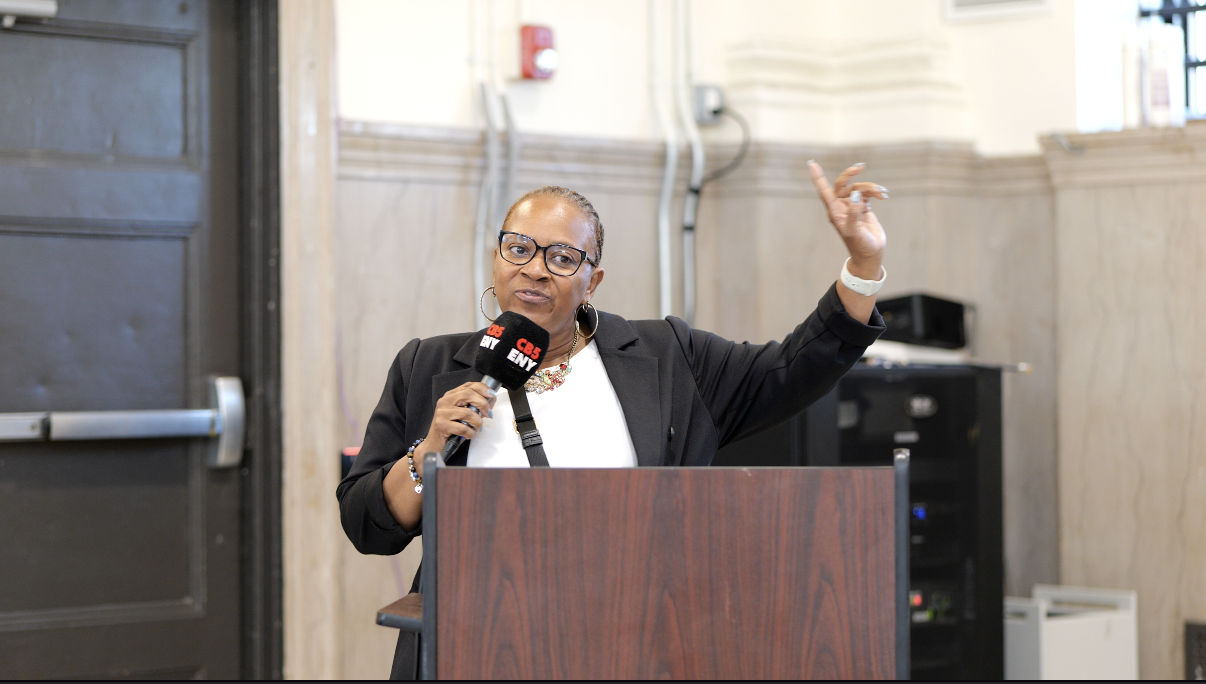
At the final Community Board 5 meeting of the session, Assemblymember Nikki Lucas did not give a generic Albany update. She delivered a detailed walkthrough of how state budget battles and legislative work are landing directly in East New York, Starrett City and Brownsville, especially around housing, education and democratic leadership.
On housing and homeowner protection, Lucas started by explaining that the late state budget was not just political drama: legislators went weeks without pay because they refused to sign off on a deal that did not protect core programs. Out of that fight, she highlighted more secure rent-freeze protections for seniors and people with disabilities, and stronger resources to combat deed theft and homeowner scams.
For East New York, she stressed, that matters because many residents are house rich but cash poor, vulnerable to fraudulent transfers and predatory schemes. To back up the policy, she pointed to her New Lots Avenue office, where a team of rotating attorneys now provides free legal services to homeowners and tenants multiple days a week. She added that her office is also preparing to offer free tax filing for residents who are late or do not know where to turn, recognizing that financial stability and housing security are tightly linked.
Lucas framed state budget work as something residents should be able to see in legal help, job training, school pathways and community-board decisions close to home.
On education and jobs, Lucas connected scholarships and training dollars to specific pathways for East Brooklyn youth and adults. She described pushing to expand a governor’s workforce scholarship beyond community colleges so four-year schools with associate programs, like Medgar Evers and similar institutions, are included. The goal is to make sure students from East Brooklyn can actually access the programs meant to train them for high-demand careers.
She then moved to workforce development on the ground. Lucas talked about securing recurring OSHA training funding and setting up partner sites where training is tied directly to employers, not just certificates. She was blunt about the problem of training without jobs, and said her approach is to link people to real placements and add mental-health and basic life-skills support so they can keep those jobs once they get them. In Linden Plaza and surrounding areas, she described a cycle of capital investment, social services, OSHA training and job placement as part of a broader plan to remake that corridor.
Perhaps the most revealing part of her presentation was about democratic leadership and process. Lucas gave CB5 a concrete example: when Assemblymember Khalil Anderson’s commuter van bill came forward, she went to Community Board 5 first, asking members for their view. She told the room that if the board had opposed the measure, she would have voted no. Because CB5 ultimately supported the pilot with conditions, she voted yes and framed it as following the board’s lead.
Lucas also previewed upcoming Civic 101 sessions, designed to help residents understand which levels of government and which offices are responsible for what. Her message was that community boards, tenant associations and homeowner groups should be part of decision-making, not informed after the fact. She invited CB5 members and residents to correct her when she is wrong and hold her accountable without canceling, reinforcing a public image of openness and partnership.